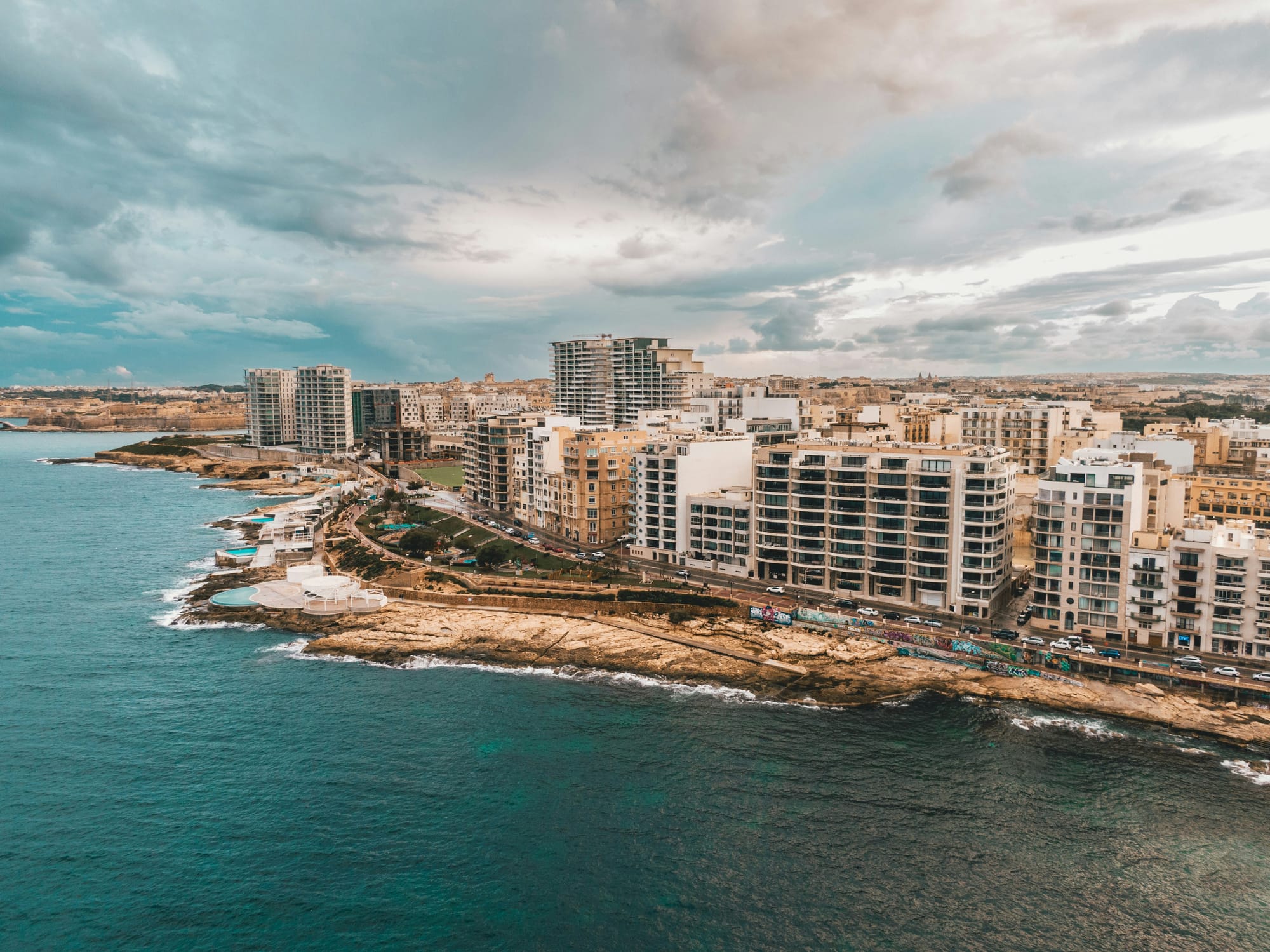
A lot of people who move to Malta end up signing their first lease in Sliema or St Julian's without really deciding to. You stay somewhere central for the first week or two while you get your bearings, get used to walking everywhere, and by the time you're actually flat-hunting, that's just where you look.
There's nothing wrong with that. But a few months in, once the novelty's worn off and the noise from the building site next door is still there at 7am, it's worth asking whether you're still getting your money's worth.
The premium, in real numbers
Sliema and St Julian's are, officially, the most expensive rental localities in Malta. That's not a portal estimate — it comes straight from the Malta Housing Authority's own rent register, which tracks leases registered under Malta's Private Residential Leases Act. Their data shows Sliema, St Julian's, and neighbouring Swieqi consistently at the top of the price table, and contracts above €2,000 a month are heavily concentrated in exactly these three spots.
For a real anchor, look at the Housing Authority's own locality breakdown: for leases starting in the first half of 2024, the registered median rent in Sliema was €1,300 for a two-bed and €1,600 for a three-bed. Compare that to St Paul's Bay — Malta's single most popular rental town — where the same-size flats had a registered median of €800 and €900. Zoom out to the region level and the Authority's modelling puts Sliema and St Julian's Northern Harbour area at the very top of the market, with rents in other parts of Malta estimated anywhere from roughly 16% to 31% lower once you control for property type and size.
So the premium isn't a myth or an agent's markup — it's documented. On those official two- and three-bed comparisons, that's an extra €500–700 a month for what could be a similar-sized flat in a less central town. Current listings suggest one-beds in Sliema and St Julian's are going for roughly €1,100–1,500 today, though that's a snapshot of active portals rather than an official figure, so treat it as a ballpark.
What you're actually paying for
To be fair to Sliema and St Julian's, that money buys something specific:
- Walkability. The seafront promenade connects both towns end to end — restaurants, gyms, supermarkets, and the sea, all on foot.
- A shorter commute. A big share of Malta's iGaming and tech jobs cluster around St Julian's and Paceville, so living there can cut a 40-minute bus ride down to a 10-minute walk.
- Move-in-ready stock. Furnished, AC-fitted apartments are more common here than almost anywhere else on the island.
- Instant social scene. Roughly a fifth of all tenants in Malta live in Sliema, St Julian's, or neighbouring Msida — which means the expat and young-professional crowd is already there, no extra effort required.
The unwanted bonuses
Here's the part fewer people mention before they sign:
- Construction noise. Both towns have seen years of near-continuous development, and cranes don't care about your lease.
- Parking that borders on impossible. If you're bringing a car, budget serious time (and possibly a separate rental) for this alone.
- Tourist crush in summer. The same promenade that's lovely in March gets genuinely difficult to walk down in August.
- Smaller or older units at the low end. Not every €1,200 flat in Sliema is a renovated seafront gem — some are dated studios trading almost entirely on the postcode.
Meanwhile, nearby towns can be noticeably cheaper — just not all by the same amount, or for the same reasons. Gżira borders Sliema directly and is genuinely walkable, though its rents only come down modestly. Msida sits a little further out but still has a stretch of harbourfront, and its registered two-bed rents ran around a quarter below Sliema's over the same period. Birkirkara is inland, so it's more of a commuting alternative than a stroll-down-the-road one — but it tends to offer the biggest savings of the three.
When the premium makes sense
It's worth it if:
- You're staying under a year and convenience beats saving a few hundred euros a month
- You don't have a car and need to walk to work, gym, and groceries
- You want the expat social scene from week one, not month three
It's probably not worth it if:
- You're budget-conscious or on a Malta-average salary
- You're moving with family and need space over proximity
- You're staying two-plus years, where €500/month extra adds up to real money fast
The smarter way to compare, not just guess
The usual approach — scrolling Facebook groups and portals, DMing ten agents, hoping someone replies before the flat's gone — makes it hard to actually compare areas side by side. You end up taking whatever comes back first, which is often whichever agent messages you fastest, not whichever flat or area actually fits.
A verified Tenant Passport on Ikri flips that. You build one profile — income range, employment, what you're looking for — and verified landlords and agents across Sliema, St Julian's, Gżira, Msida, and everywhere else come to you. You can see and compare what's actually on offer across both the premium strip and the cheaper alternatives before committing to a postcode, instead of anchoring on the first Airbnb view that hooked you.
So — worth it?
If convenience is genuinely your bottleneck — no car, short stay, want the scene immediately — yes, the Sliema/St Julian's premium buys something real. If you're chasing it mostly because it's the first place you saw Malta from, it's worth at least comparing a Gżira or Msida listing before you sign. The view is the same sea either way.
FAQ
How much more expensive is Sliema than the rest of Malta?
The Housing Authority's own modelling puts the Northern Harbour region — which includes Sliema and St Julian's — at the top of the rent scale, with other regions of Malta estimated at roughly 16–31% lower once property type and size are accounted for. In practical terms, official medians for leases starting in the first half of 2024 show Sliema's two-bed rent running about €500 above St Paul's Bay's, and its three-bed about €700 above.
What are typical asking rents in Sliema and St Julian's in 2026?
Based on a snapshot of current listings, one-bed apartments are going for roughly €1,100–1,500 a month and two-beds €1,500–2,200. These are asking prices from active portals, not an official average, so what you'll actually sign for can land above or below that range.
Is St Julian's more expensive than Sliema?
They're close. Malta Housing Authority data places Sliema, St Julian's, and Swieqi together at the top of the country's rent table, with all three towns seeing the highest concentration of contracts above €2,000 a month.
What are cheaper alternatives near Sliema and St Julian's?
Gżira borders Sliema and is walkable, though its rents come down only modestly. Msida is a bit further out but still has some harbourfront, with registered two-bed rents running about a quarter below Sliema's. Birkirkara is inland and better suited if you're not relying on walking everywhere, but it tends to offer the biggest savings of the three.
Is it worth paying the Sliema/St Julian's premium?
It depends on your priorities. It tends to make sense if you don't have a car, you're staying under a year, or you want to be near St Julian's/Paceville's office cluster. It's harder to justify for longer stays, families, or tighter budgets, where the savings from a nearby area add up quickly.
How can I compare rental options across different areas without messaging dozens of agents?
A free Tenant Passport on Ikri lets you build one verified profile and have landlords and agents across all of Malta's rental areas — premium and value alike — come to you with offers, rather than chasing listings one by one.